
How Does Radon Cause Lung Cancer?
Most people know that the #1 cause of lung cancer is cigarette smoking, but not as many know that the #2 cause of lung cancer is radon. Radon is a naturally occurring radioactive gas that forms from the breakdown of uranium in the soil and rock around one's home, school, and workplace. It seeps into homes and buildings through gaps in the foundation, cracks in floors and walls, basements, floor joints, sump pumps, porous cinder blocks, etc. Radon then becomes trapped within homes and buildings where the radioactive gas is inhaled.
How Does Radon Cause Lung Cancer?
Radon is a known human carcinogen. When radon gas breaks down, it produces radioactive particles that can be inhaled into the lungs. These particles can damage the DNA of lung cells, which can lead to genetic changes and increase the risk of developing lung cancer over time.
The risk of developing lung cancer from radon depends on factors such as the level and duration of exposure. The risk is significantly higher for people who smoke or have smoked.
Radon has a 3.8 day half-life which allows the gas to be trapped within indoor environments where it will decay into Polonium 218 and 214. When inhaled into the lungs, these radon decay products with shorter half-lives can decay into radioactive alpha particles. These radioactive particles damage the DNA of cells that line the lungs. Such cell changes are called mutations. When cells have too many mutations they can stop working correctly, grow uncontrollably, and eventually become cancerous.
Long-term exposure to radon over several years causes lung cancer. People can experience long-term radon exposure in buildings where they spend a significant amount of time such as houses, schools, apartments, and workplaces.
The process of radioactivity was discovered by Henri Becquerel and the term "radioactivity" was coined by Marie Curie. Radioactivity is the process by which an atom loses energy by emitting radiation. When it was first discovered, the harmful effects of radiation were unknown. It was originally heralded as an additive to toothpaste, watch dials, paints, butter, and cosmetics because it gave off an attractive blue/green glow-in-the-dark hue.
By the 1920s the harmful effects of unregulated radiation exposure were discovered to cause damage to cell DNA which then leads to cancer. Some of Marie Curie’s reports and papers are still so radioactive that they are stored in lead containers. Interestingly, radiation can also be used as a cancer treatment when exposure is experienced in a regulated medical dose.
Testing for Radon
Testing is the only way to know if you are living or working in a building with high radon levels. Radon measurement can be done with an easy do-it-yourself home test or by a certified radon inspector. Health Canada has set the radon action level in Canada at 200 Bq/m3.
Radonova offers the following radon test kits for homeowners and radon professionals.
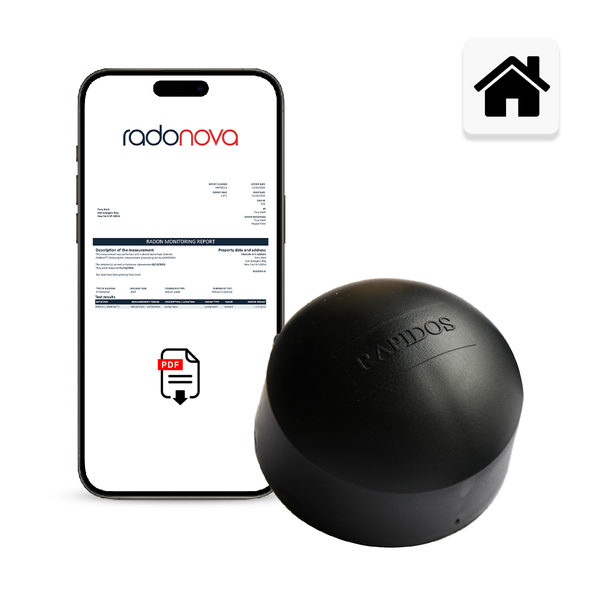
- The 10 to 90 day Rapidos alpha track detector provides detailed and accurate results in a relatively quick period.
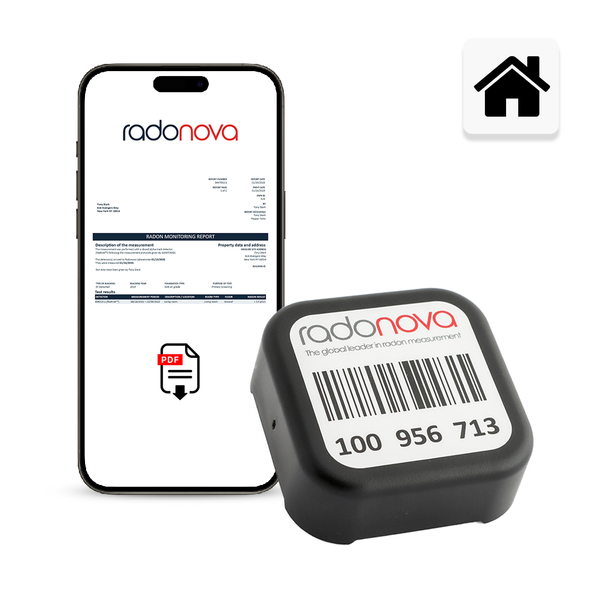
- Radtrak³ is the most popular alpha track radon detector in the world. It is deployed for up to 365 days and is the most accurate option.
Test your first floor, basement, and other first floor rooms where you spend more than 4 hours per day.
Radon reduction is relatively easy to perform inside structures once it has been detected. Radon mitigation professionals are certified to provide radon remediation that will reduce radon to the levels designated by Health Canada. Mitigating radon includes preventing radon from entering a home or workplace as well as reducing the radon level once it has entered the structure. Radon mitigation techniques include fixing cracks, securing crawl spaces, and plugging any openings that may allow radon to seep into a home or building as well as installation of pipes, fans, and venting to redistribute radon outdoors and away from inside the structure.
Our Most Popular Measurement Products